The Middle East Union Festival I
 Berliner Literarischen Aktion
Digitale Panels (als Streams) und LIVEMUSIK (vor Ort)
Mit Georges Khalil, Prof. Ella Shohat, Alaa Obeid, Sami Awad Rina Kedem, Maytha Alhassen, Natasha Kermani, Eden Cami und das Kayan Project
Kann und darf man aus dem heutigen Berlin einen friedlich vereinten Nahen Osten imaginieren? Über nationale Grenzen, Kriege, religiöse und sprachliche Unterschiede hinweg? Das Middle East Union Festival der Berliner Literarischen Aktion lässt mit Literatur, Diskurs und Musik diese Vision zum Greifen nah erscheinen. Das von Hila Amit und Mati Shemoelof kuratierte Festival gastiert im Kino Babylon (12.8.), der NoVilla (15.8.) und an zwei Tagen mit digitalen Panels und einem abendlichem Liveprogramm im LCB.
Arabisch-jüdisches Schreiben: Überlegungen zu Verdrängung und nahöstlicher Diaspora
Mit Georges Khalil und Prof. Ella Shohat digital (engl.)
https://lcb.de/programm/the-middle-east-union-festival-i/
Das gesamte Festivalprogramm auf www.middle-east-union.de

Josef Meri – Pilgrimage To The Prophet Ezekiel’s Shrine In Iraq: A Symbol Of Muslim-Jewish Relations
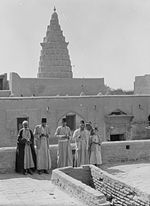
Ezekiel’s Tomb, located in Al Kifl, Iraq Photo: en.wikipedia.org
Prior to the founding of modern nation states and the evolution of nationalist thought among Jews, Christians and Muslims in the Middle East and North Africa, pilgrimage to shared shrines was a ubiquitous phenomenon up until the 20th century. However, today one still finds Jews making pilgrimage to shrines of the Talmudic sages and saints (z. addiqim) in Israel, particularly in the Galilee and Beer Sheva, and in Morocco, and Muslims to shrines associated with the prophets, and the Companions and Followers of the Prophet Muh . ammad as well as other holy persons, particularly in Egypt, Morocco, Syria, Iraq and Jordan.
This article will not deal with the theological dimensions of the veneration of holy persons or the arguments for permitting or prohibiting visiting the shrines of holy persons but rather with an aspect of saint veneration which historically attracted mainly Muslims and Jews: the veneration of the Prophet Ezekiel (Arab. H. izqīl, Dhū’l-Kifl) in Iraq.
Pilgrimage to Ezekiel’s shrine in Iraq is unique in that some of the most detailed historical accounts concerning it have been preserved.
The shrine of Ezekiel is found in the village of Kifl which lies 77 miles south of Baghdad in a largely Shi’i region and was one of the most significant places of pilgrimage for Jews and Muslims, especially Shi’is until the first half of the 20th century. As is commonly the case with other prophets and holy persons, multiple shrines were dedicated to Ezekiel. A second shrine existed in Babylonia and a third in Persia. Yet neither was as well documented as the shrine at Kifl, owing to the fact that it was a regional pilgrimage centre attracting Jews and Muslims from as far away as North Afric and the Iberian Peninsula, drawn there by the sanctity of the place and its reputation for the fulfilment of supplication and the curing of various illnesses.
Read more: https://www.academia.edu/Pilgrimage_to_the_Prophet_Ezekiels_Shrine
The Middle East Union Festival – Mehrsprachiges Literaturfestival (Englisch, Deutsch, Arabisch, Hebräisch) Berlin, 12. bis 15. August 2021
 Kann und darf man aus dem heutigen Berlin einen in Frieden und Gleichheit geeinten Nahen Osten imaginieren?
Das MIDDLE EAST UNION Festival lässt, online und verteilt auf Veranstaltungsorte in der ganzen Stadt, diese Vision zum Greifen nah erscheinen – mit Literatur, Diskurs und Musik, mit Performance, Poesie und feministischen und queeren Diskussionen.
Kuratiert von den israelischen Schriftsteller*innen Mati Shemoelof und Hila Amit und der palästinensischen Umweltaktivistin Alaa Obeid wagt das Festival ein mutiges künstlerisch-politisches Experiment: die Proklamation einer kulturellen Vereinigung des diffus kartierten Nahen Osten.
Auf die Eröffnung im BABYLON mit einem Gründungsauftakt, einer Diskussion und dem Konzert einer iranisch-israelischen Musikgruppe folgen in den darauffolgenden Tagen zahlreiche Veranstaltungen – online, im Literarischen Colloquium Berlin und in der Novilla – mit namhaften und brillanten Denker*innen, Künstler*innen und Aktivist*innen, die sich mit dem Grundgedanken des Projekts kreativ auseinandersetzen: Yehouda Shenhav-Sharabani, Ella Shohat, Amro Ali, Amina Maher, Udi Aloni, Maryam Abu Khaled, Nael Eltoukhy, Steve Sabella und viele mehr haben der Teilnahme zugesagt.
Das musikalische Programm – mit den Ensembles von Sistanagila, Eden Cami und das Kayan Project oder Rasha Nahas mit Band – bietet die Möglichkeit, eine gemeinsame Zukunftsvision auch rhythmisch und melodisch zu erkunden. Das besondere Highlight des Festivals ist ein Konzert religiöser jüdisch-arabischer Musiktraditionen mit dem Kantor Assaf Levitin und dem Ud-Spieler Mazen Ragheb Mohsen in der Synagoge am Fraenkelufer.
Bietet die kulturelle Zukunftsvision des MIDDLE EAST UNION Festivals eine Antwort auf die verhärteten Fronten und heutigen Konfliktlinien? Und wie könnte sie über die Utopie hinaus zur Wirklichkeit werden?
Finden Sie es mit uns heraus!
Für weitere Informationen und das vollständige Programm: https://middle-east-union.de/
The MIDDLE EAST UNION Festival
c/o Berliner Literarische Aktion e.V., Kastanienallee 2, 10435 Berlin
info@berliner-literarische-aktion.de, www.berliner-literarische-aktion.de
Kurator*innen: Hila Amit, Mati Shemoelof, Alaa Obeid
Projektleitung: Martin Jankowski
CEO: Lars Jongeblod
Pressekontakt: Birger Hoyer (presse@middle-east-union.de)
Ein Projekt der Berliner Literarischen Aktion nach einem Konzept von Hila Amit und Mati Shemoelof, gefördert durch den Hauptstadtkulturfonds.
The MIDDLE EAST UNION Festival – Multilingual Literature Festival (English, German, Arabic, Hebrew) Berlin, August 12th – 15th, 2021
Can and may we imagine a Middle East unified in peace and equality, in present-day Berlin? The MIDDLE EAST UNION Festival makes this vision seem within reach – with literature, discussions, and music, with performance, poetry and feminist and queer discussions, featured online and scattered across venues throughout the city.
Curated by the Israeli writers Mati Shemoelof and Hila Amit and the Palestinian environmental activist Alaa Obeid, the festival dares a bold artistic-political experiment: the proclamation of a cultural unification of the diffusely charted Middle East.
The Union launches with the opening at BABYLON and a discussion followed by a concert of an Iranian-Israeli band which will be followed by numerous events – online, at the Literary Colloquium Berlin and at the Novilla – with renowned and brilliant thinkers, artists and activists who creatively engage with the underlying idea of the project: Yehouda Shenhav-Sharabani, Ella Shohat, Amro Ali, Amina Maher, Udi Aloni, Maryam Abu Khaled, Nael Eltoukhy, Steve Sabella and many others are participating.
The music program – which will feature performances by Sistanagila, Eden Cami and the Kayan Project and Rasha Nahas with band – offers the possibility to also explore a common vision of the future through rhythm and melody. The highlight of the festival is a concert of religious Jewish-Arabic musical traditions with the cantor Assaf Levitin and the Ud player Mazen Ragheb Mohsen in the Fraenkelufer Synagogue.
Does the MIDDLE EAST UNION Festival’s cultural vision of the future offer an answer to today’s hardened fronts and lines of conflict? And how could it go beyond the idea of utopia to become reality? Join us to find out!
For more information and the full program: https://middle-east-union.de/
The MIDDLE EAST UNION Festival
c/o Berliner Literarische Aktion e.V., Kastanienallee 2, 10435 Berlin
info@berliner-literarische-aktion.de, www.berliner-literarische-aktion.de
Curators: Hila Amit, Mati Shemoelof, Alaa Obeid
Project manager: Martin Jankowski
CEO: Lars Jongeblod
Press contact: Birger Hoyer (presse@middle-east-union.de)
A project of the Berliner Literarische Aktion based on a concept by Hila Amit and Mati Shemoelof, funded by the Hauptstadtkulturfonds.
Linda Bouws – Herinner de Holocaust met wereldwijde context. Het Parool, 15 juli 2021
Linda Bouws. Foto: Het Parool
Het nieuwe Nationaal Holocaust Museum moet meer bestrijken dan de vervolging van Joden in Europa, vindt Linda Bouws. Ze pleit voor een nieuwe herinneringscultuur.
In Amsterdam wil het Nationaal Holocaust Museum de geschiedenis van de Holocaust gaan vertellen. De opening is gepland in 2022. ‘De meeste mensen weten waar de Holocaust voor staat: voor de moord op zes miljoen Europese Joden, waaronder 104.000 uit Nederland. Met uw steun willen we het Nationaal Holocaust Museum tot de plek maken waar we dat wat nooit vergeten mag worden tonen aan de toekomstige generaties. Zo’n plek is nog steeds hard nodig in Nederland,’ aldus de initiatiefnemer op de site van het Joods Cultureel Kwartier.
Er gaat niet dagelijks een nieuw historisch museum open. Zeker in deze tijd is discussie over de doelstellingen en context van zo’n initiatief onvermijdelijk. Daarbij spelen vraagstukken van identiteit en inclusie een steeds belangrijker rol. Bij een beladen onderwerp als de Holocaust zal dat zeker niet beperkt blijven tot stemmen uit Nederland of Europa.
Zo is in Dubai onlangs de eerste Holocausttentoonstelling in de Verenigde Arabische Emiraten geopend in het museum Crossroads of Civilizations. Via persoonlijke getuigenissen wordt het verhaal verteld. Een klein gedeelte is gewijd aan Arabieren en moslims die Joden hielpen de Holocaust te overleven.
Lees verder: https://www.parool.nl/herinner-de-holocaust-met-wereldwijde-context/
To A New Culture Of Remembrance
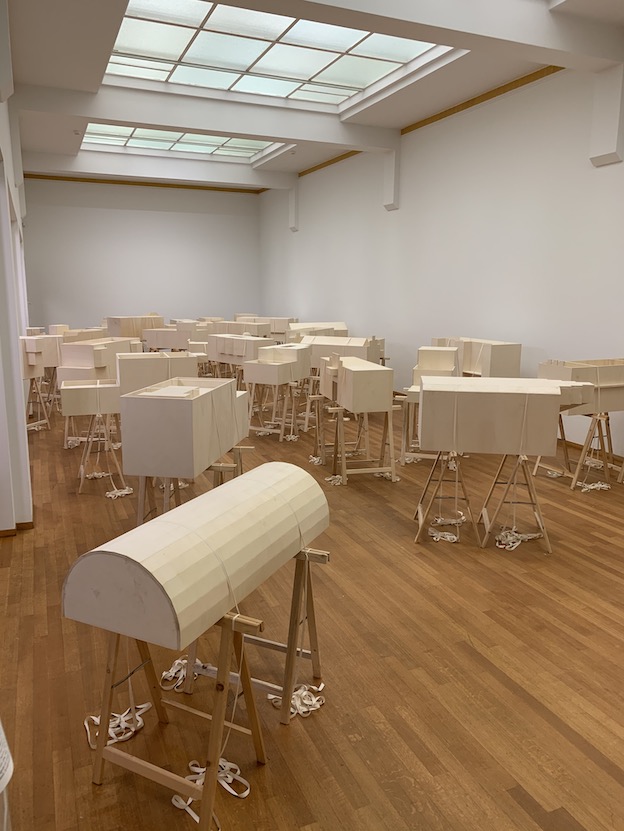
Joseph Sassoon Semah – Architectural model based on a mass grave of Jews in Baghdad – “Farhud” – the progrom against the Jews of Iraq on June 1-2 1941 – Kunstmuseum Den Haag
A new Nationaal Holocaust Museum is being built in Amsterdam to remember the history of the Holocaust. The opening is planned for 2022. An interesting initiative.
This is what the initiators said over their plan: ‘Most people know about the meaning of the Holocaust: the assassination of 6 million European Jews, of which 104.000 came from the Netherlands. With your support we want to make the National Holocaust museum the place where we show future generations that this must never be forgotten. A place like this is still very necessary in the Netherlands’. This can be read on the Jewish Cultural Quarter website.
It doesn’t happen often that a new historical museum is opened. The most recent Dutch attempt to establish a Nationaal Historisch Museum initiated by Jan Marijnissen failed miserably.
Especially in this day and age, a discussion is inevitable about the objectives and context of such an initiative. Issues of identity and inclusion play an even more important role. With such a sensitive issue as that of the Holocaust, it will certainly not be limited to voices from the Netherlands or Europe.
Just recently the first Holocaust exhibition was opened in the United Arab Emirates (UAE) in Dubai at the Crossroads of Civilisation Museum. Using personal testimonies the story of the Holocaust is told. A small part of the exhibition is dedicated to Arabs and Muslims who helped Jews survive the Holocaust. If they have devoted any attention to the Holocaust (Farhud) in the Middle East is currently unclear.
It will be inevitable for a museum that proposes to focus on future generations to be clear from the outset about the context of their museum-related activities. For example, you could add to the name Holocaust Museum: ‘The history of the Holocaust in the culture of the time and the worldwide meaning for the present’, or words with an equivalent meaning.
The Holocaust cannot be understood to be an exclusive definition of the assassination of 6 million European Jews. Hitler’s interest went beyond that of Europe. The Holocaust, albeit on a smaller scale, also took place in the Middle East. Jews in Iraq, Tunisia and Libya were persecuted and killed. In Bagdad during the Farhud on June 1st and 2nd 1941 there were around 200 victims and Jewish stores and houses were looted, destroyed and set fire to. The general presumption is, because of the later discovered mass graves, that the number of casualties was very much higher. The persecution of Jews increased after the founding of Israel in 1948. From 1950 until the seventies a huge exodus took place, mostly forced, from Arabic and South-African countries, often described as a Babylonian exile, meaning for so many the loss of a homeland, culture, traditions and stories.
Certainly in Europe, but also in the Middle-East there is a lack of knowledge and awareness of the injustice done to the Jews in the Middle-East, partly as a result of the Holocaust, after previously living harmoniously with Muslim communities in their residential and working environment.
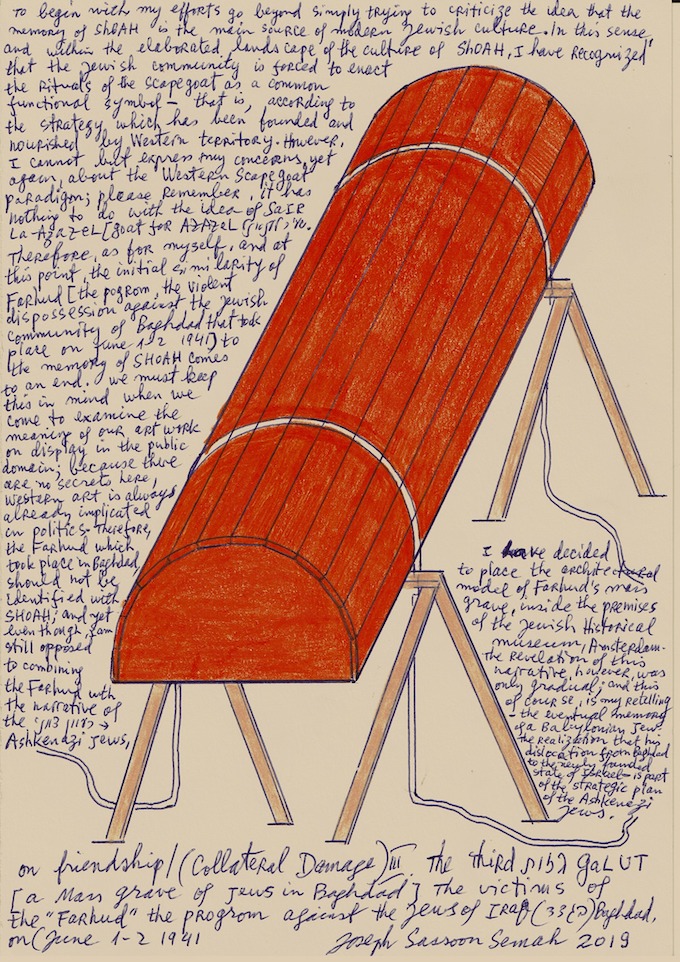
Joseph Sassoon Semah – On Friendship / (Collateral Damage) III – The Third GaLUT: Baghdad, Jerusalem, Amsterdam
If the future Nationaal Holocaust Museum in Amsterdam, a city with many cultures, wants to be interesting for future generations, then it is necessary to place the exhibitions in the context of diversity within Jewish culture of the time and the meaningfulness for the present. The National Holocaust Museum in Amsterdam has the unique possibility of taking the initiative for a new future-proof Culture of Remembrance. This means that in programming and permanent exhibitions there should be a focus on Jews from all over the world and certainly those in the Middle East; their rich culture after the first exile from Jerusalem, with among others the Talmud Bavli, the centuries of peaceful and productive living with Muslims, the ‘Kristallnacht’ there, the second exile after the founding of Israel and the emerging Mizrahi Hebrew voice in the public domain, must not be forgotten, after being marginalized for so long.
Only then will justice be done to ‘diversity and inclusivity of the Jews’ and can the question ‘Are Jews white?’ perhaps be provided with a more balanced answer.
At the Kunstmuseum Den Haag there is the exhibition ‘On Friendship …..’ until the 29th of August 2021 of work by Joseph Sassoon Semah, the grandson of the last Chief Rabbi of Baghdad, Sassoon Kadoori (1886-1971). Metaphorically speaking it is a tribute to the lost culture in Iraq, and at the same time an invitation to a dialogue about different cultures. 36 architectural models of houses, synagogues and the mass grave of Farhud, and 86 drawings bring back to life the lost, integrated Jewish culture of Baghdad.
Linda Bouws, former director Felix Meritis Amsterdam, curator exhibition
Originally published (in Dutch) in Het Parool, July 15, 2021: https://www.parool.nl/columns-opinie/opinie-herinner-de-holocaust-met-wereldwijde-context/
Translation: Jean Cameron – Amsterdam
The IHRA’s Careless Conflations On Antisemitism (And Few Alternatives)
Contending Modernities, 2021. In this essay Moshe Behar critiques the recent letter sent by English Secretary of State Gavin Williamson to university chancellors instructing them to adopt the International Holocaust Remembrance Alliances’ (IHRA) definition of antisemitism.
Behar contends that the definition of antisemitism that the IHRA has put forward is meant to squash legitimate democratic forms of criticism of the state of Israel much more than to help identify and stamp out antisemitism.
I am a non-white Mizrahi Jewish academic who has been studying Israel/Palestine and the history of Jews in the Middle East for two decades. My family hails from Ottoman Palestine, Egypt, Tunisia, and the Greek islands of Zakynthos and Corfu. All too many of us were murdered by Nazi Génocidaires (and rest assured that we will not forget or forgive).
Precisely because of this scholarly and biographic background I was embarrassed to read the letter sent by England’s Secretary of State for Education, Gavin Williamson, to all university vice chancellors. Utilizing an authoritarian tone devoid of understatement, Williamson demanded that all universities in England adopt formally what is called “the working definition of antisemitism” drafted by the International Holocaust Remembrance Alliance (IHRA).
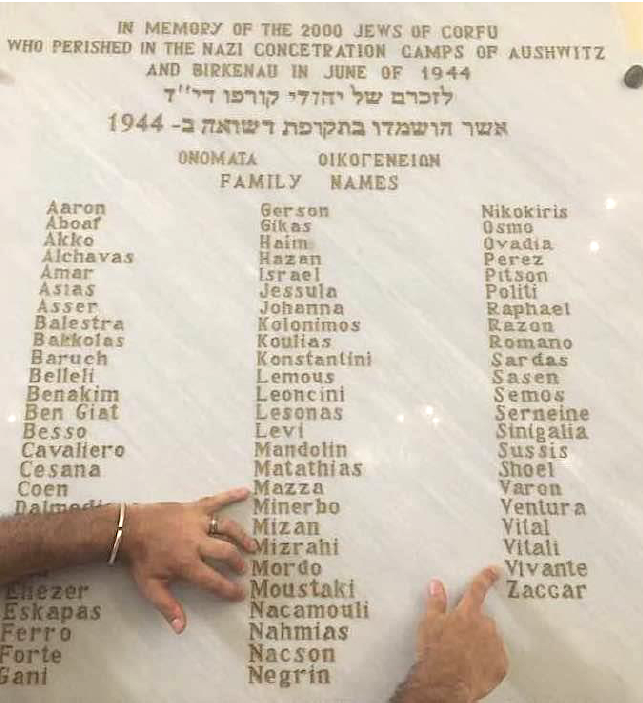
Photo from the Synagogue in Kerkyra/Corfu. Fingers pointing out to families associated with Behar’s maternal lineage, Mother’s maiden name included.
Born in 1976, Williamson has been a Tory politician for 25 years. He and his party have not been noteworthy for their passionate activism against racism, antisemitism included. Nor did Williamson find it problematic to serve under Boris Johnson, author of Seventy-Two Virgins (HarperCollins, 2004), a novel that disappointingly recycled antisemitic tropes and stereotypical portrayals of Jews and other British minority ethnic groups.
The letter Williamson authored is littered with antisemitic tropes. A non-Jew himself, Williamson first chooses to single out Jews from non-Jews and, in so doing, officially mark Jews as “other.” Embracing the “divide and conquer” colonial approach, he proceeds to divorce antisemitic racism from similar manifestations of racism with which he is less concerned, including Islamophobia, Afrophobia/anti-Black racism, misogyny, anti Roma/Gypsy racism, homophobia, and xenophobia vis-à-vis Asians and Arabs.
Most disturbingly, Williamson’s letter upgrades the quintessential stereotype of money and Jews to a new level by linking Jews to monetary penalties and potential state sanctions on universities if their managements exercise what is otherwise a simple academic and democratic right to adopt a view and definition of antisemitism that differ from his. The irony of setting Christmas as the deadline for his pseudo-philosemitic mobilization has apparently escaped Williamson altogether.
The IHRA definition that Williamson labors to impose unilaterally defines antisemitism as “a perception that may be expressed as hatred.” This reading is vague, restrictive, minimalist, and in the main emotionalist. It bypasses manifestations of antisemitism that are equally, and possibly even more, important than “perception,” including oppression, discrimination, exclusion, prejudice, bigotry or other tangible actions. Moreover, a wall-to-wall agreement prevails among the rainbow of scholars of antisemitism that one singular definition of the abhorrent phenomenon does not exist. That is the case precisely as there is no one and only definition for racism, feminism, islamophobia, Judaism, Zionism, Islamism, English nationalism, communitarianism, and forms of bigotry.
There are at least four additional definitions of antisemitism that can guide the work of scholars or activists and that are analytically superior to that of the IHRA: the definition of the Canadian Independent Jewish Voices; that of the British Board of Deputies and the Community Security Trust; and that of the British Jewish Voice for Labour. However, the most scholarly rigorous definition is “The Jerusalem Declaration on Antisemitism” (JDA) that was made public today (disclosure: some serious reservations notwithstanding, I’m one of its 200 academic signatories). To be sure, Williamson’s top-down state decree of a single definition upon academia let alone one deemed deficient by hundreds of scholars runs the risk of echoing Soviet Stalinism and American McCarthyism.
And Then There Is Israel
As many as seven of the eleven illustrations that the IHRA definition marshals to exemplify antisemitism relate to post-1948 Israel (of which I happen to be a citizen). The Zionist/Arab matrix dominates the definition and as a result it often comes across as concerned more with the protection of Israel than the protection of Jews, let alone non-Israeli Jews. As early as 2016 the British Government’s own “Home Affairs Committee” found the IHRA’s definition wanting; cross-party committee members insisted on formally affixing two stipulations: (1) “It is not anti-Semitic to criticise the Government of Israel, without additional evidence to suggest anti-Semitic intent” and (2) “It is not anti-Semitic to hold the Israeli Government to the same standards as other liberal democracies, or to take a particular interest in the Israeli Government’s policies or actions, without additional evidence to suggest anti-Semitic intent ” (italics added).
While it is unclear how precisely such “intent” is to be established or proven let alone by what body or individual/s it is clear that Williamson opted consciously to exclude these two surgical qualifications. That seems an additional testament to his instrumentalization of antisemitism for sectarian conservative ends. The Governing Bodies and Presidents/Vice Chancellors of at least 48 universities were unable to withstand the ongoing governmental pressure and effectively all endorsed the IHRA definition top-down without staff consultation. For example, my university’s management endorsed the definition with the Home Affairs Committee’s stipulations; Cambridge and Oxford did the same. While this too remains unsatisfactory, it is somewhat less misguided than adopting the IHRA definition as is.
The definition Williamson insists on imposing carelessly conflates “Jews” with “the state of Israel” and “Judaism” with “modern political Zionism.” The original conflation between these identities and phenomena was and remains an inherent organizing pillar of Zionist ideology. Self-proclaimed pro-Israel bodies and individuals exercise this conflation regularly in texts, actions, and advocacy. It comes as no surprise that this conflation has often been reproduced by Israel’s anti-Zionist critics, at times consciously and at other times as a consequence of inexcusable ignorance.
Recent example of irresponsible conflation between British Jews, Zionism, and Israel’s belligerent occupation.
The symbiosis between these opposing, yet mutually-empowering, Zionist/anti-Zionist tides yields the most toxic ground for unambiguous manifestations of antisemitism. This is in contrast to cases where straightforward criticisms of Israel including by such organizations as Amnesty International, Oxfam, Human Rights Watch, and the Open Society Institute (established in 1993 by George Soros) have been fancifully labelled as “antisemitic” to delegitimize pro-democratic activism on behalf of Palestinian human and political rights. Three facts that the IHRA definition fails to acknowledge should neither be forgotten nor blurred conceptually: that many Jews are not Zionist; that the majority of Zionists worldwide are not Jewish (including Christian fundamentalists); and that over 20% of Israeli citizens are not Jewish.


On Friendship/(Collateral Damage)
Recent On Friendship/(Collateral Damage) Articles
- On Friendship / (Collateral Damage) V – Between Graveyard And Museum’s Sphere
- Bijeenkomst & boekpresentatie: Joseph Beuys en de naoorlogse (kunst)geschiedenis: Een ander perspectief.
- In Berlin, Mizrahi Activists Face An Identity Conflict Over Judicial Protests
- Joseph Sassoon Semah: On Friendship / (Collateral Damage) IV – How to Explain Hare Hunting to a Dead German Artist
- Performance Joseph Sassoon Semah with Friends – Display of the WOUND
Random On Friendship/(Collateral Damage) post (refresh page to renew)
- Lumen Travo Gallery – Amsterdam: Joseph Sassoon Semah – Solo exhibition ‘On Friendship / (Collateral Damage) IV
- Sophie Levy ~ Fiction, Poetry, And The Shaping Of Mizrahi Cultural Consciousness
- Linda Bouws ~ Joseph Sassoon Semah: Re-Thinking The Concept Of GaLUT, Re-Claiming The Lost Culture
- Ari Alexander ~ The Jews Of Baghdad And Zionism: 1920-1948
- Smadar Lavie – Mizrah Feminism And The Question Of Palestine
- On Friendship / (Collateral Damage) IV – A Critical Project On Post-War Artist Joseph Beuys
- Ella Shohat – Dislocated Identities: Reflections Of An Arab-Jew
- On Friendship / (Collateral Damage) IV – How to Explain Hare Hunting To A Dead German Artist – Maarten Luther Kerk – Amsterdam
- The Art Of Cooking – Hummus With Minced Meat
- The Art Of Cooking – Aruk

Search this site
About
Support
Like us on Facebook
Archives
- April 2024
- March 2024
- February 2024
- January 2024
- December 2023
- November 2023
- October 2023
- September 2023
- August 2023
- July 2023
- June 2023
- May 2023
- April 2023
- March 2023
- February 2023
- January 2023
- December 2022
- November 2022
- October 2022
- September 2022
- August 2022
- July 2022
- June 2022
- May 2022
- April 2022
- March 2022
- February 2022
- January 2022
- December 2021
- November 2021
- October 2021
- September 2021
- August 2021
- July 2021
- June 2021
- May 2021
- April 2021
- March 2021
- February 2021
- January 2021
- December 2020
- November 2020
- October 2020
- September 2020
- August 2020
- July 2020
- June 2020
- May 2020
- April 2020
- March 2020
- February 2020
- January 2020
- December 2019
- November 2019
- October 2019
- September 2019
- August 2019
- July 2019
- June 2019
- May 2019
- April 2019
- March 2019
- February 2019
- January 2019
- December 2018
- November 2018
- October 2018
- September 2018
- August 2018
- July 2018
- June 2018
- May 2018
- April 2018
- March 2018
- February 2018
- January 2018
- December 2017
- November 2017
- October 2017
- September 2017
- August 2017
- July 2017
- June 2017
- May 2017
- April 2017
- March 2017
- February 2017
- January 2017
- December 2016
- November 2016
- October 2016
- September 2016
- August 2016
- July 2016
- June 2016
- May 2016
- April 2016
- March 2016
- February 2016
- January 2016
- December 2015
- November 2015
- October 2015
- September 2015
- August 2015
- July 2015
- June 2015
- May 2015
- April 2015
- March 2015
- February 2015
- January 2015
- December 2014
- November 2014
- October 2014
- September 2014
- August 2014
- July 2014
- June 2014
- May 2014
- April 2014
- March 2014
- February 2014
- January 2014
- December 2013
- November 2013
- October 2013
- September 2013
- August 2013
- July 2013
- June 2013
- May 2013
- April 2013
- March 2013
- February 2013
- January 2013
- December 2012
- November 2012
- October 2012
- September 2012
- August 2012
- July 2012
- June 2012
- May 2012
- April 2012
- March 2012
- February 2012
- January 2012
- December 2011
- November 2011
- October 2011
- September 2011
- July 2011
- June 2011
- May 2011
- April 2011
- March 2011
- February 2011
- January 2011