The Double Edge Theater’s Project To ‘Rematriate Land’

April M. Short
03-19-2024 ~ Meet a theater group that left the city to reimagine a local economy.
The economic realities in the U.S. do not generally support working-class artists and culture bearers—an issue that has only been exacerbated by the COVID-19 pandemic. According to a March 2021 report titled “Solidarity Not Charity: Arts and Culture Grantmaking in the Solidarity Economy,” 63 percent of creatives in the U.S. were “fully unemployed” as of December 2020 and one-third of museums said they would not open after the pandemic. The report was commissioned and released by Grantmakers in the Arts to encourage investors to fund arts and culture more broadly.
Perhaps because there are seldom mainstream systems of support for artists in the U.S., they are often the ones responsible for envisioning equitable ways of living and being. It is artists who often create alternatives to the existing economic models, spearheading many of the mutual aid efforts that have helped communities survive challenging times (this became especially visible during the early years of the COVID-19 pandemic), coming up with housing solutions like community-owned land trusts and co-ops, and offering the means to relocalize supply chains. As the Solidarity Not Charity report details, artists are building what is often called the solidarity economy or local peace economy.
The Double Edge Theatre, a cultural cooperative and ensemble collective in Ashfield, Massachusetts, offers an example of how artists have successfully reimagined the economy and created networks of mutual support. The company was founded in Boston in 1982, but by the end of the 1980s, gentrification and rising costs in the city made it difficult for the group to enact its creative visions, according to Carlos Uriona, an actor and the theater’s cultural strategist. This economic pressure became the catalyst for a unique model leading to a community-supported economy that has become a successful haven for the arts for decades.
As the theater’s mission statement notes, their “… [v]ision is to prioritize imagination in times of creative, emotional, spiritual, and political uncertainty.”
The theater has been repatriating 105 acres of farmland for the purpose of promoting culture—or as Uriona puts it, they have been “rematrating” the land, as the theater was initially founded and largely led by women.
“By the early 1990s, [the theater members] were looking for an alternative model,” he says, noting that at the time he was not yet part of the theater, as he arrived in 1996 from Argentina after being offered residency. “They [Double Edge Theatre] wanted to create a model where they could rehearse and produce work, but at the same time invest in long-term research projects and deeper work,” Uriona says. “They also wanted to be able to collaborate intensively with foreign countries, and a lot of those countries were on the other side of the iron curtain during those days—[like] Eastern Europe and Central Europe—they also wanted to work with people in South America. In Boston, at the time, the idea of bringing people like me on board for a residency, and housing them, was nearly impossible.”
The group searched for an alternative space outside the city, and in 1994 they found the farm where they currently reside: 105 acres of land in rural Massachusetts. The farm is classified as Agricultural Preservation Restriction (APR) land and the company purchased it as a collective, with the understanding that they could not develop the land into condos or use it for other purposes. Instead, they would have to farm, live, and work in the farmhouse and farm buildings.
While most of the members of the theater were relatively urbanized, they decided to take a leap of faith and learn how to farm—with the intention of building a community where actors could dedicate themselves to the theater full time and stay with projects for a long term without outside strains. Rather than having to take a second job to fund housing and living expenses, at the farm, one “day job” for the members of the theater became farming, where they produced their own food, and eventually, took up other necessary projects like carpentry. They also worked on administrative duties at the theater, including marketing and writing grants.
For a few years, the group juggled both locations: Boston and Ashfield, but in 1997 they made the choice to commit fully to the farm, which Uriona says felt like a significant risk at the time.
“We decided to move the group completely [to Ashfield] knowing it was a risk,” he says. “Everybody was telling us, ‘You’re probably not going to be able to make a theater work out there and you’re not going to be able to fund it; you’re sinking money into something that is not going to work.”
When the theater bought the farm, small farms were already under significant strain in the post-Nixon era, which saw an increasingly industrialized Big Ag takeover, and the economic realities of small-scale farming were bleak. It was clear that the farm would not produce enough to fund the members of the group.
Meanwhile, the surrounding town, made up of many small farmers, was undergoing a reconversion as conventional small-scale farming was becoming unsustainable. The neighboring farms also started moving into boutique farming models, which were oriented toward specialized organic produce. Some became bed-and-breakfasts (many of which are now Airbnbs, and some are alternative teaching organizations).
“[Surrounding farms] stopped farming in the way they had been doing and a new system started,” he said. “At the same time, people were starting to get jobs on the internet.”
With all of these factors at play, the group knew it needed to develop its own economic model. They knew they wanted to create something that was not just based on producing theater and delivering theater.
“We didn’t want to subject our creation and our research to the entertainment industry; we wanted to remain an art group,” Uriona says. “One of my strong suits is outreach and developing a cultivation of people—not just the cultivation of plants and animals, and stuff like that. So, that allowed me to reach out to a lot of farmers here [Ashfield] and gain their trust and their cooperation.”
Little by little, the group developed a strong connection with the surrounding town and became intricately connected with the developing businesses as farms restructured. Read more



We Need A Plan For The Transition To Renewable Energy
 03-18-2024 ~ Radical societal transformation is inevitable; a plan could make a difference between catastrophe and progress.
The transition to renewable energy is inevitable given the current climate crisis and the fact that fossil fuels are a finite resource. To make the shift, a detailed plan is required to indicate the first steps and anticipate challenges in allocating resources and the policies needed to achieve the outcome. Germany has arguably accomplished more toward the transition to renewable energy than any other nation, largely because it has such a plan—the “Energiewende,” which seeks a 60 percent reduction in all fossil fuel use by 2050 and a 50 percent reduction in primary energy use through efficiency in power generation, especially for buildings and the transport sector.
What follows are some components of a basic plan that can be adapted according to each country or state and adjusted for contingencies.
Level One: The ‘Easy’ Stuff
The easiest way to kick-start the transition is to switch to solar and wind power for electricity generation by building lots of panels and turbines, respectively, while phasing out coal. Distributing generation and storage of these energy sources (rooftop solar panels with home- or office-scale battery packs) will help. Replacing natural gas will be harder because gas-fired “peaking” plants are often used to buffer the intermittency of industrial-scale wind and solar inputs to the grid.
Electricity accounted for less than a quarter of all final energy used in the United States in 2022. Since solar, wind, hydro, and geothermal produce electricity, it makes sense to electrify even more of our energy usage—heating and cooling buildings with electric air-source heat pumps and cooking with electric induction stoves, for example.
Transportation represents a large swath of energy consumption, mostly due to the growing number of personal cars. As of 2021, there were 250 million gasoline-fueled automobiles. While we are busy replacing these with electric vehicles, we can easily and cheaply promote walking, bicycling, and public transit.
Substantial retrofitting is needed for energy efficiency. Building codes should be strengthened to mandate net-zero or near-net-zero energy performance for new construction. Zoning codes and development policies should encourage infill development, multifamily buildings, and clustered mixed-use development. Using more energy-efficient appliances will also help.
The food system is a significant energy consumer. Increasing the market share of organic local foods can dramatically lower the amount of fossil fuels used to manufacture fertilizers as well as in food processing, and in transportation. We can also sequester enormous amounts of atmospheric carbon in topsoil by promoting farming and land management practices that build soil rather than deplete it.
By our calculations, these actions could reduce carbon emissions by 40 percent in 10 to 20 years.
Level Two: The Harder Stuff
Solar and wind technologies provide energy intermittently. When they become dominant, we must adapt to this with substantial amounts of grid-level energy storage and a major grid overhaul to get the electricity sector to 80 percent renewables. We’ll also need to time our energy usage to coincide with sunlight and wind energy availability.
The transport sector will require extensive and costly restructuring. Densified cities and suburbs can be reoriented to public transit, bicycling, and walking. All motorized human transport can be electric, with more public transit and intercity passenger rail links. Heavy trucks could run on fuel cells, but it would be better to minimize trucking by expanding freight rail. Sails would increase the fuel efficiency of shipping, but relocalization or deglobalization of manufacturing would be a necessary co-strategy to reduce the need for shipping.
Although much of the manufacturing sector runs on electricity, many raw materials used during the manufacturing processes either are fossil fuels or require fossil fuels for mining or transformation. By replacing fossil fuel-based materials and by increasing the recycling of nonrenewable materials, we can reduce dependency on mining.
If we do all this and build far more solar panels and wind turbines, we could, by our calculations, achieve roughly an 80 percent reduction in emissions. Read more
Venezuela’s Election In The Crosshairs Of New U.S. Regime Change Scheme
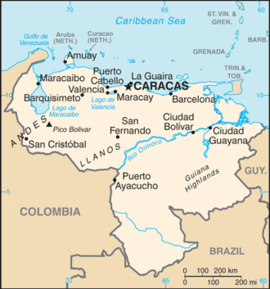
Venezuela – Source: wikipedia.org
03-15-2024 ~ As Venezuela prepares to head to the polls in July, the U.S. has already started drumming up suspicion and doubt around the electoral process.
Twenty-five years after Hugo Chávez took office and began the Bolivarian Revolution in Venezuela, U.S. officials have still not tired of dreaming up new plots to overthrow the country’s government. Five years ago, following the last presidential election, they attempted to install Juan Guaidó—a politician most Venezuelans had never even heard of—as the country’s head of state. And now, with the date for the next presidential election officially set for July 28, the Biden administration is gearing up for the biggest regime-change push since the Guaidó coup attempt.
Venezuela has long been a target for U.S. intervention because of its efforts to build an alternative model to the neoliberal capitalism pushed by institutions like the IMF and World Bank. First theorized and implemented under the leadership of Chávez, the Bolivarian Revolution in Venezuela puts forward a new model that emphasizes using the country’s resources, such as its oil revenue, to fund crucial missions. These then guarantee rights such as education, food, housing, transportation, culture, and sports to historically excluded majorities, to decrease longstanding socioeconomic inequality. A central part of the Bolivarian Revolution is the political and cultural transformation of the people through the promotion of Venezuelan national culture, internationalism, anti-imperialism, and the empowerment of all people as political subjects with rights and responsibilities. It is a project in direct contradiction to U.S. interests in the oil-rich country and the region Washington considers its backyard.
The 2024 Elections
President Nicolás Maduro is running for re-election as the candidate of the United Socialist Party of Venezuela (PSUV) and the broader Great Patriotic Pole coalition. He has built his campaign around a program referred to as the “Seven Transformations,” proposing major new initiatives in the fields of economic modernization, asserting national sovereignty, safety and security, ensuring social rights, political participation, the environment, and geopolitics. These aim to maintain the pro-poor, socialist orientation of the country’s development model while enacting reforms to stimulate greater economic activity and counteract the impact of crippling U.S. sanctions.
The opposition is divided into several different camps. The largest coalition of opposition parties is called the Unitary Platform and consists of parties or factions of parties controlled by the Venezuelan elite who were displaced from positions of power as a result of the Bolivarian Revolution. The Unitary Platform has taken part in several rounds of negotiations with the government over the past year leading up to the elections and signed an agreement last October known as the “Barbados Agreement.”
In this agreement, the opposition was granted concessions on issues related to the organization of the electoral process, and in exchange, the United States agreed to loosen some sanctions relating to Venezuela’s oil and mining industries. The Barbados Agreement stipulated that only opposition figures who are eligible according to existing laws would be permitted to run. At this stage, the Unitary Platform has not chosen a candidate.
The specifics of how the electoral process will be carried out, regulations on campaigning on media platforms, participation of electoral observers, and the updating of electoral rolls were outlined in an agreement signed on February 28. The agreement was the product of dialogue among over 150 political and social organizations and was based on over 500 proposals. Ninety-seven percent of the political parties registered with the National Electoral Council participated.
Nonetheless, U.S. officials have presented this electoral process, subject to such extensive deliberation and approved with such wide support, as an attack on democracy.
María Corina Machado and the Fraud Narrative
The approach of the U.S. government follows a familiar script—wage a campaign in the media and through international organizations to cast doubt on the integrity of the electoral process so relentlessly that the result can be presented as fraudulent no matter what the actual evidence is on election day.
The key piece of the “electoral fraud” narrative is already in place and revolves around the disqualification of the opposition figure María Corina Machado.
Machado is the oldest daughter of Henrique Machado Zuloaga, who was an executive of Sivensa. One of Venezuela’s largest steel companies, Sivensa was nationalized in 2008 under Hugo Chávez. Since the start of the Bolivarian Revolution, Machado has been active in the right-wing opposition and has gone so far as to support destabilization campaigns and attempts to overthrow Venezuela’s democratically elected governments. She served as a member of Venezuela’s National Assembly from 2011-2014.
In July 2015, the Venezuelan comptroller general’s office announced that Machado was barred from holding public office for a period of one year after neglecting to disclose the extent of her earnings while she held public office. Read more
Nepal Experiences Another Political Reversal As Public Takes A Backseat
 03-15-2024 ~ Nepal’s recent political changes, forming a coalition government led by the two largest communist parties, have implications for stability. Pushpa Kamal Dahal’s continued prime ministership and the inclusion of smaller parties signal shifting alliances.
On March 4th, Nepal’s two largest communist parties united to establish a new coalition government, including smaller parties as partners. Pushpa Kamal Dahal, leader of the Maoist party, will continue as prime minister, a year after his initial election. Dahal has severed ties with the Nepali Congress Party, the largest parliamentary group, and has allied with the Communist Party of Nepal (Unified Marxist-Leninist), the second-largest party led by Khadga Prasad Sharma Oli. Following the shift in coalition dynamics, the prime minister is obligated to seek a vote of confidence in Parliament within 30 days, a process anticipated to result in his favor.
The new Left Alliance coalition will consist of four political parties: the Communist Party of Nepal (Maoist Centre), the Communist Party of Nepal-Unified Marxist Leninist (CPN-UML), the Rastriya Swatantra Party, and the Janata Samajbadi Party or People’s Socialist Party.
The increasing rift between the Maoist Centre and Nepali Congress parties regarding the claim to the chairmanship of the National Assembly—Nepal’s upper house of government—had posed a significant threat to the already delicate ruling coalition.
Following its Standing Committee meeting on February 28, the Maoist Centre opted to fight for the National Assembly chairmanship while Dahal had promised support to the Nepali Congress (NC) in the election for the Chair. Nepali Congress President Sher Bahadur Deuba intended for the party’s senior figure and recently elected legislator, Krishna Prasad Sitaula, to take on the position of National Assembly Chairman.
Dahal, known for leading a decade-long armed struggle against the then-monarchy starting in 1996, transitioned into mainstream politics following a 2006 peace deal facilitated by the United Nations. Although currently serving his third term as prime minister, he is yet to complete a full five-year term. Since abolishing its 240-year-old monarchy in 2008 and becoming a republic, Nepal has witnessed the formation of 13 governments.
The Electoral System in Nepal and the State of the Parties
The Federal Parliament of Nepal is structured into two houses: the House of Representatives and the National Assembly. The House of Representatives is composed of 275 members, with 165 elected through a first-past-the-post system, representing specific constituencies, and the remaining 110 chosen via proportional representation. On the other hand, the National Assembly comprises 59 members. In this house, each of the seven provinces elects eight members through an electoral college, and the President additionally appoints three members based on government recommendations.
The Nepali Congress (NC), a center-left social democrat party, is the largest party in the House of Representatives, securing 89 seats. Close behind is the Left Wing Communist Party of Nepal (Unified Marxist–Leninist) (CPN-UML), led by KP Sharma Oli, with 79 seats. Dahal’s party, the Communist Party of Nepal (Maoist Centre), holds 30 seats. The Rastriya Swatantra Party has 21 seats, while the Janata Samajbadi Party has 12 seats. The newly formed coalition of these latter four parties boasts a combined strength of 142 seats.
Dahal holds the role of kingmaker due to the intricate coalition dynamics in Nepal. The Nepali Congress and the Communist Party of Nepal (Unified Marxist–Leninist) have a history of ups and downs in their relationship, preventing them from forming an alliance at present. Despite past collaborations, their governments collapsed due to disputes over various issues. This leaves them with no alternative but to consider Dahal’s party as a potential alliance partner. Dahal’s credibility is further bolstered by his past leadership in the struggle for democracy. Read more
How Effective Is International Aid And Assistance?

John P. Ruehl – Source: Independent Media Institute
03-15-2024 ~ Assistance outcomes differ by country, but special interests and the absence of a unified vision increase the risk of mismanagement and corruption. Rising debt levels across the developing world suggest these policies may be nearing their zenith.
On February 1, 2024, Ukraine secured a €50 billion aid package from the European Union (EU), aimed at bolstering its defense capabilities and facilitating the country’s reconstruction. Dozens of other countries, along with Western-dominated multilateral lenders like the International Monetary Foundation (IMF) and the World Bank, as well as private investors, have contributed billions of dollars in aid to Ukraine since Russia’s invasion in 2022. Billions more are pledged.
While international support has been crucial for Ukraine, Kyiv will be expected to pay much of this back. Approximately half the global population now live in countries where debt payments exceed spending on education and healthcare. While wealthier countries can manage debt sustainably, poorer countries face challenges in avoiding the detrimental effects of excessive debt, leading to stunted development.
Ukraine remains in desperate need of foreign financial assistance, humanitarian aid, infrastructure development, military support, and technical capacity building. However, quiet caution has emerged among various international supporters. Ukraine’s capacity to implement Western-backed political, economic, and corruption reforms, expel Russian forces, and repay loans is being questioned. The hesitation underscores the challenges of coordinating a diverse array of donors over time.
The EU has been the primary source of financial assistance for Ukraine, and the recent approval of its latest aid package followed months of debates between member states. The IMF also provided a $15.6 billion loan in 2023, marking the first IMF loan awarded to a country at war. Foreign investors have meanwhile increasingly sought guarantees and insurance for investing in Ukraine, with the Ukrainian government working with the World Bank to implement such policies.
The U.S. has provided the bulk of Ukraine’s foreign military aid, but the most recent $60 billion in military assistance has been stalled for months due to opposition in Congress. Republican support for Ukraine has declined markedly since the early days of the war, leading proponents of the pending military aid package to emphasize its benefits for U.S. companies, job creation, and reducing the maintenance costs of holding or destroying U.S. weapons stockpiles.
However, this line of thinking has ignited pushback from across the political spectrum. Republican politicians have become increasingly critical of providing Ukraine with a “blank check,” while accusations of potential money laundering have been raised. The lack of a long-term, bipartisan strategy toward Ukraine from Washington has left defense contractors hesitant to increase arms production, already under scrutiny for price-gouging during increased demand.
Adding to this reluctance is concern in the U.S. over establishing long-term outlets for defense contractors. For instance, since 1979, the U.S. has given Egypt roughly $50 billion in military aid, including fighter jets, helicopters, tanks, armored personnel carriers, surveillance aircraft, counterterrorism training, and border security assistance. After Congress canceled half of the annual payment of $1.2 billion to Egypt in 2013 following a military-led coup (as well as $250 million in annual economic aid), U.S. officials noted that the U.S. government would have to pay for the missed shipment and the costs of winding down the programs. Aid to Egypt was later fully reinstated in 2015,
Despite the resumption of military aid to Egypt, persistent questions surround the allocation of these funds. It has helped prevent Egypt from becoming adversarial, but Cairo has nevertheless grown closer to China and Russia since 2013. U.S. weapons manufacturers maintain lucrative export opportunities, but this assistance has also helped enrich and strengthen Egypt’s military and has empowered it to absorb other forms of foreign aid. The IMF’s conditions on giving Egypt a $3 billion loan in 2023 hinged on the military government’s commitment to political and economic reform, but this remains unlikely.
Egypt, with a debt of $11 billion, stands as the IMF’s second-largest debtor country, following Argentina ($32 billion) and ahead of Ukraine ($9 billion). The World Bank counts India ($39 billion), Indonesia ($19 billion), and Pakistan ($18 billion) as its top debtors. The combined global debt owed to the IMF and World Bank tops $300 billion, with their global reach having expanded significantly from their original focus on rebuilding Europe after World War II.
These organizations began large-scale crisis intervention in developing countries in the early 1980s to address their foreign debt challenges. As the U.S. raised interest rates to combat inflation, dollar-denominated loans caused significant defaults and debt restructuring, particularly across Latin America.
The IMF and the World Bank advocated for privatization of industries and export-driven industrialization, eliminating trade barriers and granting foreign corporations easier access to raw materials. Beginning in the 1980s, conditions associated with Structural Adjustment Programs (SAPs) saw economic growth return, but aid recipients became more market-dependent and reliant on the IMF and World Bank, while wages remained low through devalued currencies.
The end of the Cold War and the establishment of the modern global financial system saw credit-hungry governments shifting their reliance on countries and multilateral organizations to embrace private lenders, including private equity and venture capital. Read more
The Left Needs A Positive Vision For How Immigration Policy Should Actually Work
 03-11-2024 ~ As Democrats move right on immigration, the left must boldly embrace open borders, says author John Washington.
Militarized borders — comprising walls, barriers, fences and repressive border policies — have become something of the norm in today’s world, which otherwise is in favor of the free movement of goods and capital. But that wasn’t always the case. The United States, for example, had no federal immigration laws during the first century of its existence.
There are strong moral, political and economic arguments to be made against borders. In fact, the idea that the free movement of people across borders is detrimental to security and economic growth is largely based on biases and misconceptions, as John Washington points out in the exclusive interview for Truthout that follows.
Washington is a journalist and author of the brilliant and provocative book The Case for Open Borders, which was published last month by Haymarket Books.
C.J. Polychroniou: The issue of border security has become a hot political issue in the U.S. since former President Donald Trump entered the political scene. In fact, immigration today is driving support for Trump more than in 2016, forcing Democrats and President Joe Biden in turn to embrace tougher border measures, including proposals for shutting down the U.S.-Mexico border. Now, you have just published a book titled The Case for Open Borders in which you seek to draw attention to the advantages of open border policies while knowing fully well that such arguments are highly unlikely at this political moment to find much, if any, support in mainstream society. Indeed, you recognize yourself in the book that “open borders” is a concept reviled by people across the political spectrum. So, what motivated you to write a book on this topic at this point in time?
John Washington: The political class has tried, failed, tried again and failed again to do what they claim they want to be doing with border and immigration enforcement. That history of failure goes back decades, even centuries. We have evidence showing long-, medium- and short-term flops of border enforcement measures failing to stop migration. While such evidence ranges internationally, I’ll give a few U.S.-focused numbers here to underscore my point.
Currently, about 15 percent of the U.S. population is foreign-born, which is pretty much exactly what it was 100 years ago. The pattern follows globally. About 3.5 percent of global population are considered international migrants. That percentage has held steady for about 100 years despite dramatic increases in border enforcement. Those percentages now represent a vastly larger number of people.
Let’s drill down a bit more: The U.S. immigrant population born in Latin America and the Caribbean was roughly 3 million in 1970 but grew to over 22 million as of 2019. That period exactly tracks the rise of modern immigration and border enforcement. So not only have these percentages held steady, but, despite vast expenditures and the militarization of borders, in gross numbers, far more people are crossing them today.
One other example of how deterrence measures don’t work: In the months immediately following the most inhumane and well publicized of recent immigration enforcement measures, the family separation policy which was broadly implemented in 2018 (similar measures have existed before and after), more families came to the U.S.-Mexico border seeking protection. People move. They have, they do and they will move, and walls and crackdowns haven’t, don’t and won’t stop them.
So we can continue the extravagantly expensive and morally bankrupt charade of claiming border enforcement measures do what they purport to do — stop migration — or we can try a different and more humane approach.
I don’t think that support for Trump has forced Democrats to implement more severe and inhumane border policies. Democrats are responsible for their own failures and their own inhumanity on this issue.
What I aimed to do with this book was bring some clarity to a contentious and largely misunderstood idea, to take back a term and the concept, “open borders,” which is not a pipe dream or a dystopia but a means of extending freedom and justice.
You write in the book that the term “open borders” seems to be easily misunderstood even by people who are sympathetic to immigration. What exactly do you mean by “open borders,” and what’s the logic behind it?
Open borders could mean a lot of things, and I’m not aiming to have the perfect recipe or to try to prescribe concrete next steps. But I can offer what I think are some necessary ingredients: Opening borders must be coupled with ceasing the worst of extractive cutthroat capitalism as well as fighting for people’s “right to remain.”
To answer the first part of your question more concretely: I think open borders could look like what the European Union looks today, but without the militarized border of “fortress Europe” surrounding it. It could look like other passport-free zones throughout the world. It could look like the U.S., where people are free to cross state and jurisdictional borders, relocate to new communities with vastly different cultures, cuisines, climates and languages, where they are compelled to register, to civically engage and pay into the collective pot through taxes with the presumption that they are welcome.
Open borders are not to just knock down the wall, but also to reallocate the boondoggle expenditures toward resettlement and human and environmental reparations. It could make for more orderly human movement: people traveling through and registering at ports of entry rather than taking to the rivers, seas and deserts. Read more

Search this site
About
Support
Like us on Facebook
Archives
- April 2024
- March 2024
- February 2024
- January 2024
- December 2023
- November 2023
- October 2023
- September 2023
- August 2023
- July 2023
- June 2023
- May 2023
- April 2023
- March 2023
- February 2023
- January 2023
- December 2022
- November 2022
- October 2022
- September 2022
- August 2022
- July 2022
- June 2022
- May 2022
- April 2022
- March 2022
- February 2022
- January 2022
- December 2021
- November 2021
- October 2021
- September 2021
- August 2021
- July 2021
- June 2021
- May 2021
- April 2021
- March 2021
- February 2021
- January 2021
- December 2020
- November 2020
- October 2020
- September 2020
- August 2020
- July 2020
- June 2020
- May 2020
- April 2020
- March 2020
- February 2020
- January 2020
- December 2019
- November 2019
- October 2019
- September 2019
- August 2019
- July 2019
- June 2019
- May 2019
- April 2019
- March 2019
- February 2019
- January 2019
- December 2018
- November 2018
- October 2018
- September 2018
- August 2018
- July 2018
- June 2018
- May 2018
- April 2018
- March 2018
- February 2018
- January 2018
- December 2017
- November 2017
- October 2017
- September 2017
- August 2017
- July 2017
- June 2017
- May 2017
- April 2017
- March 2017
- February 2017
- January 2017
- December 2016
- November 2016
- October 2016
- September 2016
- August 2016
- July 2016
- June 2016
- May 2016
- April 2016
- March 2016
- February 2016
- January 2016
- December 2015
- November 2015
- October 2015
- September 2015
- August 2015
- July 2015
- June 2015
- May 2015
- April 2015
- March 2015
- February 2015
- January 2015
- December 2014
- November 2014
- October 2014
- September 2014
- August 2014
- July 2014
- June 2014
- May 2014
- April 2014
- March 2014
- February 2014
- January 2014
- December 2013
- November 2013
- October 2013
- September 2013
- August 2013
- July 2013
- June 2013
- May 2013
- April 2013
- March 2013
- February 2013
- January 2013
- December 2012
- November 2012
- October 2012
- September 2012
- August 2012
- July 2012
- June 2012
- May 2012
- April 2012
- March 2012
- February 2012
- January 2012
- December 2011
- November 2011
- October 2011
- September 2011
- July 2011
- June 2011
- May 2011
- April 2011
- March 2011
- February 2011
- January 2011