OVT – VPRO ~ Het spoor terug, de koloniale kater St. Eustatius
 Sint Eustatius was de belangrijkste doorvoer- en handelshaven van de West Indische Compagnie. Het eiland werd in de achttiende eeuw ook wel de Gouden Rots genoemd. Het was verreweg het rijkste koloniale bezit in de west en via Sint Eustatius hielp Nederland de Amerikanen in 1776 met hun oorlog tegen de Engelsen. Een Amerikaans schip werd er zelfs begroet met elf saluutschoten, die door Amerika prompt werden geïnterpreteerd als de eerste erkenning van hun onafhankelijkheid.
Maar hoe kijken de Sint Eustatianen aan tegen hun fiere koloniale verleden. Pieter-Bas van Wiechen ging naar het eiland en maakte de documentaire ‘De koloniale kater van Sint Eustatius’.
Luister: http://m.radio1.nl/Eustatius.html



Building Bridges: Cities And Regions In A Transnational World. Regional Studies Association Annual Conference 2016, Graz, Austria
 Registration is now open!
Throughout history, cities and regions have been cornerstones of economic, social and cultural institution building and centres of communication and trade across borders of empires and nations. In a globalised world dominated by multi-level governance and declining economic and political significance of the nation-state, cities and regions are becoming ever more so important in building bridges across nations, supra-national unions, and even continents.
These challenges surpass the usual aspects of integration: it is not sufficient to reduce barriers for the mobility of labour, goods, services and capital, to create a homogenous competitive environment, and a solid monetary system. What is needed in addition are more elements of a new regionalism, which is based on non-hierarchical relationships, on self-government, and on the creation of flexible alliances leading to interregional transnational cooperation. The development of a region is affected by its competitive and complementary relationships with other increasingly distant regions.
Read more: http://www.regionalstudies.org/building-bridges-cities
TEDTalk – Lisa Bu ~ How Books Can Open Your Mind
What happens when a dream you’ve held since childhood … doesn’t come true? As Lisa Bu adjusted to a new life in the United States, she turned to books to expand her mind and create a new path for herself. She shares her unique approach to reading in this lovely, personal talk about the magic of books.
Harvard Classics (Bookshelf)
 The Harvard Classics, originally known as Dr. Eliot’s Five Foot Shelf, is a 51-volume anthology of classic works from world literature, compiled and edited by Harvard University president Charles W. Eliot, that was first published in 1909.
Dr. Eliot, then President of Harvard University, had stated in speeches that the elements of a liberal education could be obtained by spending 15 minutes a day reading from a collection of books that could fit on a five-foot shelf. (Originally he had said a three-foot shelf.)
The publisher P. F. Collier and Son saw an opportunity, and challenged him to make good on this statement by selecting an appropriate collection of works; the Harvard Classics was the result. Eliot worked for one year together with William A. Neilson, a professor of English; Eliot determined the works to be included and Neilson selected the specific editions and wrote introductory notes (Kirsch 2001). Each volume had 400 to 450 pages or so; and the included texts are “so far as possible, entire works or complete segments of the world’s written legacies” (Going 2006).
The collection was widely advertised by Collier and Son, in Collier’s Magazine and elsewhere, with great success. As Adam Kirsch, writing in 2001 Harvard magazine, notes, “It is surprisingly easy, even today, to find a complete set of the Harvard Classics in good condition. At least one is usually for sale on eBay, the Internet auction site, for $300 or so, a bargain at $6 a book. The supply, from attics or private libraries around the country, seems endless—a tribute to the success of the publisher, P.F. Collier, who sold some 350,000 sets within 20 years of the series’ initial publication” (Kirsch 2001). A separate 20-volume selection by Eliot, the Harvard Classics Shelf of Fiction, was published in 1917.
Collier’s was a major publisher of sets in the early 1900s and throughout the century issued many multi-volume sets of authors as diverse as Charles Dickens, Rudyard Kipling, John Steinbeck, P. G. Wodehouse and Arthur Conan Doyle.
Currently, a hardcover set of the Harvard Classics (now in the public domain) is published by Easton Press and a paperback version by Kessinger Publishing.
See: https://www.gutenberg.org/Harvard_Classics_(Bookshelf)
George Context ~ Affordable Housing And The Future Of London As A Creative City

Flickr/401(K) 2012.Some rights reserved.
The question of how to mitigate, let alone solve, the problem of London’s cost-of-breathing crisis, sorry, cost-of-living crisis seems inescapable, like a perverse and all too real Millennium Prize Problem. It appears as though we have bound so far down an economic cul-de-sac, justified on the quasi-religious neo-classical truths of supply and demand and global competition, that advertising a £450,000 one bedroom flat as ‘ideal for first time buyers or as a pied-à-terre’ is apparently perfectly acceptable. The problems this plight presents are real and well discussed – homelessness, families evicted by unscrupulous buy-to-let landlords (who are perhaps second only to investment bankers in the UKs Most Despised Persons list), and overcrowding. What estate agents gleefully herald as ‘gentrification’, the newly elected Labour leader evocatively decries as ‘ethnic cleansing’. However, I want to consider this housing crisis from an alternative perspective, one informed as much by my career as a musician as it is by my academic desire to understand the operation, and consequences of, contemporary creative markets in urban contexts. I want to question the cultural ramifications of this housing crisis; the artistic implications of a farcical situation whereby, for example, Help to Buy is required by magic-circle lawyers – as per a great friend of mine recently. In short, what does the housing crisis mean for art, and for the future of London as a creative city.
Read more: https://www.opendemocracy.net/george-context/affordable-housing-and-future-of-london
Raul Dancel ~ Dreaming Of Own Home In Manila’s Slums
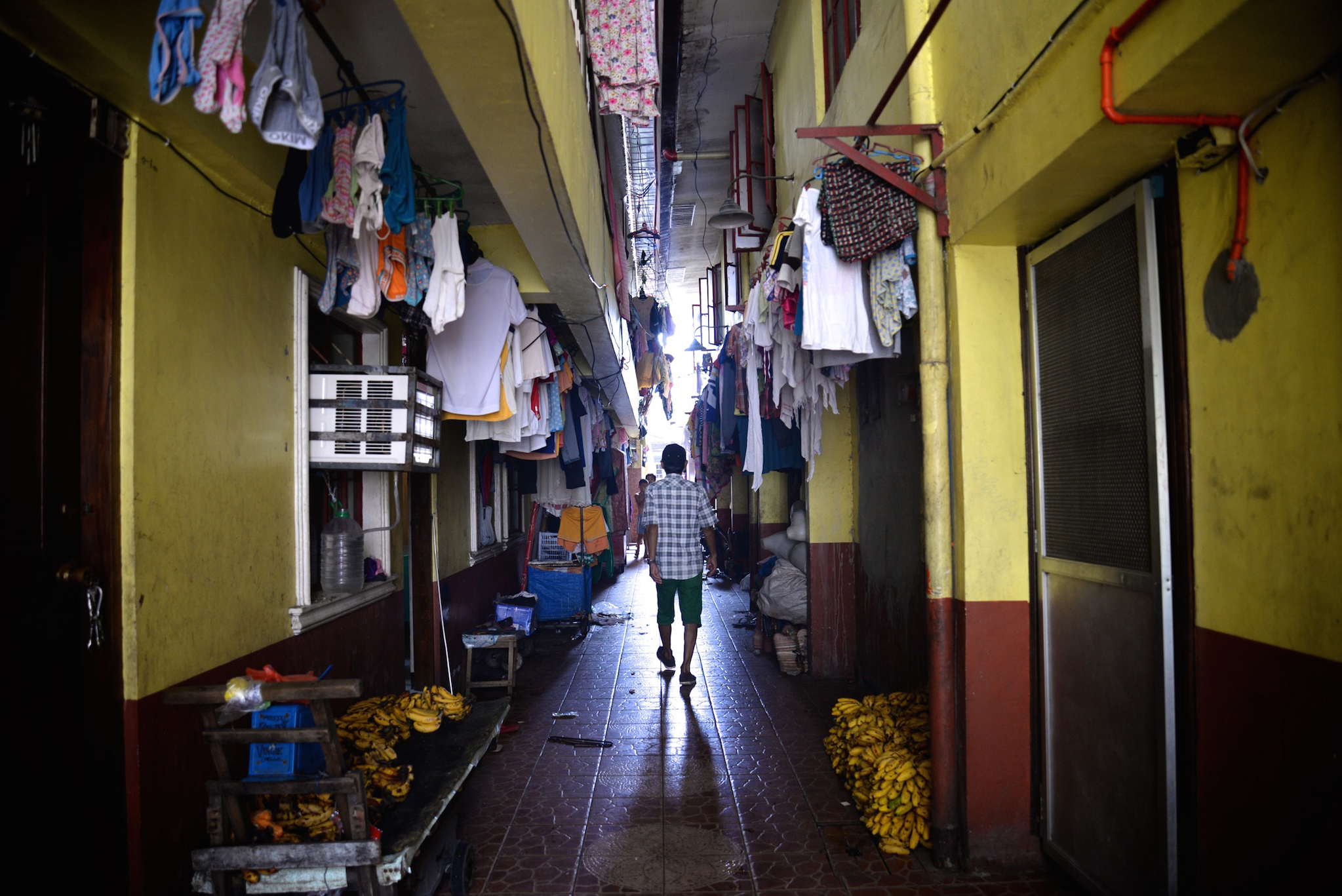
A row of decrepit apartments built on government land in Baclaran, a sprawling poor district south of Manila. In 1946, there were about 46,000 slum dwellers in Manila. Now, metropolitan Manila is host to about 2.1 million slum dwellers. -ST PHOTO: RAUL DANCEL
MANILA • I grew up in one of the many slums scattered all around metropolitan Manila. Ours was just south of Manila, in Baclaran, a district known for a sprawling shrine dedicated to the version of the Virgin Mary known as the Lady of Perpetual Help.
It was fitting, really. I always felt our neighbourhood was in perpetual need of help. We lived in one of the upper floors of a row of decrepit two-storey flats our landlord somehow managed to build on land he did not own. It was government land.
It was in the middle of thousands of shacks that were really nothing more than cardboard, plywood and tin sewn together with nails, chicken wire and adhesive tape covered with galvanised steel and held in place with cement blocks, used tyres and other heavy debris.
Read more: http://www.straitstimes.com/opinion/dreaming-of-own-home-in-manilas-slums
Search this site
About
Support
Like us on Facebook
Archives
- April 2024
- March 2024
- February 2024
- January 2024
- December 2023
- November 2023
- October 2023
- September 2023
- August 2023
- July 2023
- June 2023
- May 2023
- April 2023
- March 2023
- February 2023
- January 2023
- December 2022
- November 2022
- October 2022
- September 2022
- August 2022
- July 2022
- June 2022
- May 2022
- April 2022
- March 2022
- February 2022
- January 2022
- December 2021
- November 2021
- October 2021
- September 2021
- August 2021
- July 2021
- June 2021
- May 2021
- April 2021
- March 2021
- February 2021
- January 2021
- December 2020
- November 2020
- October 2020
- September 2020
- August 2020
- July 2020
- June 2020
- May 2020
- April 2020
- March 2020
- February 2020
- January 2020
- December 2019
- November 2019
- October 2019
- September 2019
- August 2019
- July 2019
- June 2019
- May 2019
- April 2019
- March 2019
- February 2019
- January 2019
- December 2018
- November 2018
- October 2018
- September 2018
- August 2018
- July 2018
- June 2018
- May 2018
- April 2018
- March 2018
- February 2018
- January 2018
- December 2017
- November 2017
- October 2017
- September 2017
- August 2017
- July 2017
- June 2017
- May 2017
- April 2017
- March 2017
- February 2017
- January 2017
- December 2016
- November 2016
- October 2016
- September 2016
- August 2016
- July 2016
- June 2016
- May 2016
- April 2016
- March 2016
- February 2016
- January 2016
- December 2015
- November 2015
- October 2015
- September 2015
- August 2015
- July 2015
- June 2015
- May 2015
- April 2015
- March 2015
- February 2015
- January 2015
- December 2014
- November 2014
- October 2014
- September 2014
- August 2014
- July 2014
- June 2014
- May 2014
- April 2014
- March 2014
- February 2014
- January 2014
- December 2013
- November 2013
- October 2013
- September 2013
- August 2013
- July 2013
- June 2013
- May 2013
- April 2013
- March 2013
- February 2013
- January 2013
- December 2012
- November 2012
- October 2012
- September 2012
- August 2012
- July 2012
- June 2012
- May 2012
- April 2012
- March 2012
- February 2012
- January 2012
- December 2011
- November 2011
- October 2011
- September 2011
- July 2011
- June 2011
- May 2011
- April 2011
- March 2011
- February 2011
- January 2011